
Key Takeaways
- P0352 means the ECM detected a fault in the Coil B primary or secondary circuit. It reports a circuit problem, not necessarily an active misfire.
- Coil B corresponds to cylinder 2 on most coil-on-plug applications, but confirm the assignment against the wiring diagram before pulling a coil.
- The real risk is the catalytic converter. Raw fuel from a misfiring cylinder can overheat and destroy the catalytic converter.
- In some applications, a failed coil can damage the ECM, so check the module before returning the vehicle.
- Test the power, ground, and control circuits before condemning the coil. A wiring fault reads the same as a failed part.
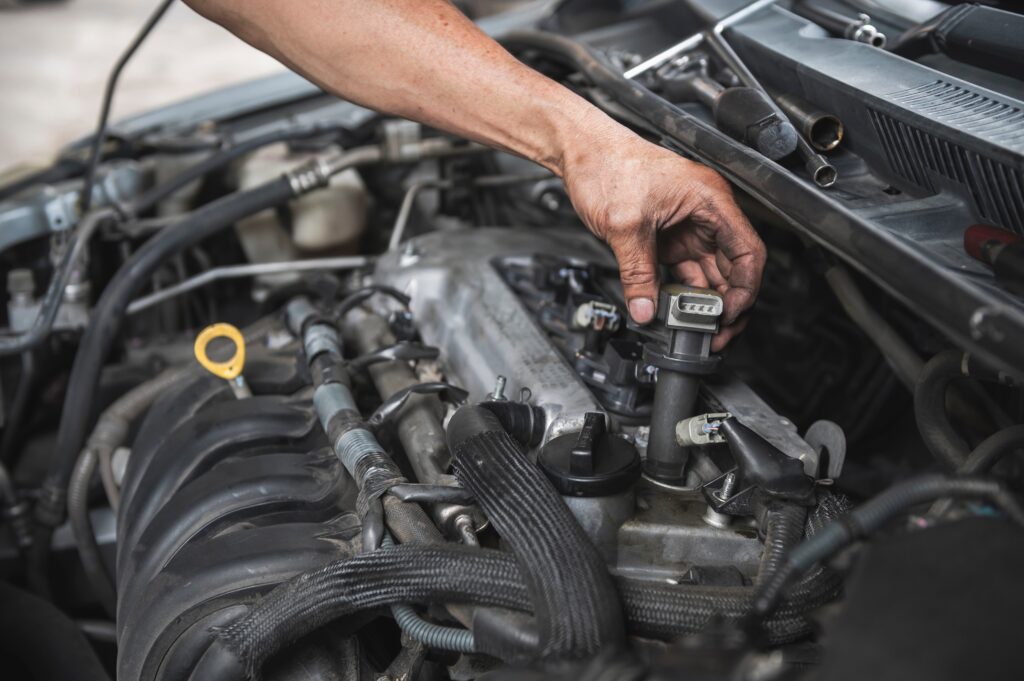
Problems in the Coil B ignition circuit trigger Diagnostic Trouble Code (DTC) P0352, a generic OBD-II code that should be addressed promptly to avoid further damage. Code P0352 can illuminate the check engine light (CEL), cause misfires, and reduce engine performance. Although a malfunctioning ignition coil is a primary cause of this diagnostic code, several other electrical or mechanical issues can also trigger it.
The diagnostic and repair guide below explains DTC P0352, its potential causes, diagnostic procedures, and potential solutions. Please keep in mind that the information provided is neither exhaustive nor tailored to a specific vehicle make, model, or model year. For the most accurate repair information, refer to the Identifix Direct-Hit® platform to view over 3 million confirmed fixes for trouble codes such as P0352.
What Does Code P0352 Mean?
The engine control module (ECM) stores the P0352 DTC, “Ignition Coil B Primary/Secondary Circuit Malfunction,” when there is a problem with the ignition coil B circuit.
The code breaks down as follows:
- P indicates powertrain.
- 0 signals the trouble code is generic rather than manufacturer-specific.
- 3 references the ignition system.
- 51 through 58 index the coil letter, so 52 corresponds to Coil B.
On most coil-on-plug applications, Coil B is cylinder 2. That mapping is a convention, not a rule, because the letter identifies an ECM output driver rather than a cylinder. Wasted-spark systems further complicate it, since a single coil serves two cylinders. Confirm the assignment against the application wiring diagram before removing a coil.
The distinction between a circuit code and a misfire code matters too. P0352 reports a fault in the coil circuit. A misfire code, such as P0302, indicates combustion failure in a cylinder. The two often appear together, but a coil can fail and set only a misfire code, and a chafed wire can set P0352 even if the engine runs smoothly.
This DTC can cause a CEL, an engine misfire, powertrain vibrations while idling and driving, or a loss of engine power.
Address the cause promptly. A misfiring cylinder sends raw fuel into the exhaust, which can overheat and destroy the catalytic converter. GM’s own procedure for coil-related misfires directs technicians to inspect the related catalytic converter for damage or overheating and replace it as necessary. [1] Converter replacement typically costs more than the ignition repair that caused it.
Common Vehicle Problems That Trigger Code P0352
DTC P0352 indicates a communication problem between the ECM and the ignition coil. Understanding the link between these two components is essential to determine what may be at fault.
An ignition coil is a transformer with no moving parts. Battery voltage flows through the primary winding, generating a magnetic field around the coil. When the ECM interrupts that current, the field collapses across the secondary winding, inducing the high voltage that jumps the spark plug gap.
The ECM controls the timing of that interruption, and it monitors the circuit for opens, shorts, and abnormal current. P0352 sets when those readings fall outside the expected range.
Potential causes of DTC P0352 include the following:
- Defective ignition coil.
- Damaged, corroded, or chafed coil wiring.
- Loose connector, corroded terminal, or short to power or ground.
- Open coil power feed or blown ignition coil fuse.
- A failed ECM output driver.
A worn or fouled spark plug can contribute by raising secondary resistance and stressing the coil, though it more often sets a misfire code than a circuit code.
This code is prone to misdiagnosis, especially when multiple faults exist. Conditions such as vacuum leaks, throttle body deposits, or idle control faults cause rough running and can set misfire codes, but they do not set a coil circuit code. Diagnose those separately rather than treating them as causes of P0352.

Diagnostics for P0352 Code
A coil circuit fault, a wiring fault, and a failed ECM driver all present the same way on a scan tool. Work through the circuit in order rather than replacing the coil first, since a new coil installed on a damaged circuit will fail again. The table below summarizes what each result points to.
| Finding | Indicates |
| Coil resistance outside specification | Failed coil |
| No power at the coil feed | Open circuit or blown ignition coil fuse |
| No ground at the coil | Open ground circuit or corroded terminal |
| No control signal from the ECM | Wiring fault or failed ECM driver |
| Fault follows the coil when swapped | Failed coil |
| Fault stays with the cylinder | Wiring, connector, or ECM circuit |
Scan for additional trouble codes
Record every stored and pending code with freeze-frame data before clearing anything. Companion misfire codes indicate whether combustion is actually failing, and multiple coil codes across a bank point to a shared power feed, fuse, or harness rather than several coils failing at once. Note any emissions codes stored alongside it, since faults such as P0442 on a gasoline application or P20EE on a diesel block inspection readiness independently.
Inspect the ignition coil and connector
Remove the coil and inspect the body and boot for cracking, carbon tracking, and heat damage. Check the connector terminals for corrosion, spread pins, and moisture, and look for water trails or rust in the spark plug well. Test primary and secondary resistance against the manufacturer’s specification for the application.
GM’s guidance for heat-stressed coils on the 3.6L V6 adds a useful distinction: inspect the sides of the coil’s top for damage from voltage or heat stress, and note that traces or lines visible under the epoxy are not heat damage. [1] Misreading normal epoxy artifacts as failure leads to unnecessary replacement.
Test coil power and ground
Confirm the coil receives battery voltage on its feed circuit with the key on, and verify a good ground with a voltage drop test rather than a continuity check. An open fuse can take out an entire bank of coils, which explains multiple coil codes appearing together.
Check coil control circuit
Trace the harness from the ECM to the coil and look for chafing, melted insulation, and corrosion, paying attention to any point where the harness routes against another component. Check the control circuit for continuity to the ECM connector and for shorts to power or ground. If power, ground, and wiring all test correctly and the coil is known good, the fault lies in the ECM driver.
Test the spark plug and ignition system
Inspect the spark plug for wear, fouling, incorrect gap, and damage. An excessive gap increases secondary demand and stresses the coil. Where the application allows, swap the coil with an adjacent cylinder and re-run the vehicle. If the code follows the coil, the coil has failed. If it stays with the original cylinder, the fault is in the wiring, connector, or ECM circuit.
How to Fix P0352 Code
The solution for DTC P0352 depends on the diagnosis. Component replacement resolves most cases, but the repair only holds if you also correct the circuit that damaged the part.
Replace the faulty ignition coil
Replace the coil when resistance falls outside specification, the body shows heat or voltage damage, or the fault follows the coil on a swap test. Use the part specified for the application, as aftermarket coils are a common source of recurring failures across several platforms.
Repair damaged wiring
Repair chafed, melted, or corroded wire rather than splicing over the damage and leaving the cause in place. If a harness has rubbed against another component, secure and protect the run before reassembly, or the fault will return.
Replace the spark plug
Replace plugs that are worn, fouled, or out of gap specification, and correct whatever fouled them. Installing a new coil onto a worn plug puts the new part under the same secondary load that stressed the original.
Repair electrical connections
Replace corroded terminals and damaged connectors instead of cleaning and reusing them. Check the ignition coil fuse when multiple coil codes appear on one bank, since an open fuse disables every coil it feeds. [1]
Repair or replace the PCM
Consider the module only after the coil, wiring, connectors, power, and ground all test correctly. In some applications, a failed coil can damage the ECM driver, so you must address both the module and the coils. GM’s procedure for affected 3.6L V6 applications directs technicians to replace all six coils and the ECM together and warns against starting the engine before the work is complete because doing so can damage the new module. [1]
How Serious Is the P0352 Code?
P0352 is more urgent than most circuit codes because of what an unaddressed misfire does downstream. The vehicle will usually drive, but the consequences compound.
A cylinder that does not fire sends unburned fuel into the exhaust. That fuel ignites in the catalytic converter, drives substrate temperature past its design limit, and can melt it. The resulting catalyst code, such as P0420 turns an inexpensive coil job into a converter replacement.
Treat a flashing check engine light as an immediate. A steady lamp with mild symptoms allows a short drive to a shop, but not weeks of deferral.
Find Tailored Solutions for P0352 by Make and Model
The code definition is standardized, but coil design, failure patterns, and the correct repair path differ by application. Confirm the VIN, engine, and model year before applying any of the patterns below.
P0352 Toyota
A P0352 Toyota concern most often points to the coil itself. The 3.5L V6 used across Camry, Avalon, Highlander, Sienna, RAV4, and Venza has a well-documented coil failure pattern, and independent Toyota specialists report that these codes frequently appear without an accompanying misfire code, even when the vehicle runs smoothly on arrival.
That matters for diagnosis. A Toyota P0352 with no misfire code and no drivability complaint is still a real circuit fault; do not dismiss it just because the engine sounds fine. Confirm coil resistance and the control circuit before returning the vehicle.
P0352 Chevy
GM Preliminary Information PIP5038 covers 2009 Traverse, 2009 Acadia, 2009 Enclave, 2009 Outlook, and 2008 to 2009 CTS and STS with the direct-injected 3.6L V6, and lists P0351 through P0356 alongside P0300 through P0306. The cause is a heat-stressed or damaged ignition coil. [1]
The applicability gate is visual. If no coil shows damage from voltage or heat stress, the bulletin does not apply, and you continue diagnosis through normal service information. Where damage is present, the specified repair replaces all six coils and the ECM, checks the ignition coil fuse when misfires appear on one bank, and inspects the catalytic converter for overheating. [1]
P0352 Ford
A P0352 Ford diagnosis should start with a review of the harness routing. Ford service information documents engine wiring harness chafing against an air conditioning line near the PCM on 2005 to 2006 F-150 applications, which can set any P0351 through P0358 codes without a coil failure.
Ford also documents coil failures that damage the PCM on the 3.5L V6, where the specified repair replaces the module along with all coils and plugs. Check the module condition before returning any P0352 Ford repair, since a new coil on a damaged driver fails immediately.
P0352 Honda
Honda applications use coil-on-plug ignition, with the coil connector exposed at the top of the valve cover, where oil seepage past the plug tube seals is a common source of contamination. Inspect the plug wells for oil before testing the coil, as an oil-filled well degrades the boot and can cause repeat failures after replacement.
P0352 Nissan
On Nissan applications, confirm which cylinder the ECM assigns to Coil B for the specific engine, rather than assuming cylinder 2, particularly on V6 configurations where the firing order and bank layout differ from those of inline engines. Check the current service information for the VIN before removing a coil.
P0352 vs. Other Ignition Coil Codes
The ignition coil circuit codes run in sequence, with each letter corresponding to one ECM output driver. The table below shows the range.
| Code | Coil | Typical cylinder |
| P0351 | Coil A | 1 |
| P0352 | Coil B | 2 |
| P0353 | Coil C | 3 |
| P0354 | Coil D | 4 |
| P0355 | Coil E | 5 |
| P0356 | Coil F | 6 |
P0350 is the general ignition coil primary or secondary circuit code and does not identify a specific coil.
Two patterns are worth recognizing. Several coil codes appearing together on one bank usually indicate a shared power feed, an open fuse, or a chafed section of the harness rather than several coils failing simultaneously. A coil circuit code paired with the matching misfire code, such as P0352 with P0302, confirms the fault affects combustion rather than sitting dormant in the circuit.
A knock sensor circuit code such as P0332 is a separate fault, but it can appear alongside ignition problems and should be diagnosed on its own evidence.
Referencing Identifix Direct-Hit® gives you the coil resistance specification, wiring diagram, and confirmed fixes for the exact vehicle rather than a generic procedure.
Request a Direct-Hit demo to see how vehicle-specific data prevents the repeat coil failure that follows a missed wiring fault.
See Other Related P Code Articles
P0420 | P0300 | P0171 | P0128 | P0456 | P0442 | P0332 | P20EE | P0455 | P0113 | P0174 | P0301 | P0172 | P0011 | P0299 | P0700
FAQs
Can I drive with the P0352 code?
A vehicle with a steady check engine light and mild symptoms can usually make it to a shop. Don’t defer the repair, because unburned fuel from a misfiring cylinder can damage the catalytic converter. Stop driving if the light flashes, since that indicates a misfire severe enough to cause damage quickly.
How much does it cost to fix P0352?
Cost depends on what the testing finds. A single coil and plug are inexpensive repairs in most applications. A chafed harness adds diagnostic time, and a failed ECM driver adds a module plus programming. If the converter has already been damaged, the replacement typically exceeds the cost of the ignition repair itself.
How do I clear the P0352 code?
Repair the cause first, then clear the code with a scan tool. Operate the vehicle so the misfire monitor can run, and confirm that no pending codes are returned. A cleared lamp on its own does not prove the repair worked.
Is P0352 the same on all vehicle makes?
The definition is standardized across OBD-II, but the coil-to-cylinder assignment, the resistance specification, and the correct test procedure vary by application. Coil B is cylinder 2 on most coil-on-plug engines, though the letter identifies an ECM driver rather than a cylinder position. Always confirm with the vehicle’s wiring diagram.
References
- General Motors LLC. (2012, July). SES light engine misfire and/or shudder: Inspect ignition coils (Preliminary Information PIP5038). National Highway Traffic Safety Administration. https://static.nhtsa.gov/odi/tsbs/2012/SB-10045342-9886.pdf

Identifix is the leading provider of automotive repair shop solutions and sevices designed to improve shop profitability and repair outcomes.