
Key Takeaways
- P0301 means the PCM counted enough misfire events on cylinder 1 specifically to store a cylinder-identified code.
- Knowing the cylinder unlocks swap testing, which a random-misfire code doesn’t allow.
- Raw fuel from a misfiring cylinder can overheat the catalytic converter, which is an expensive downstream risk.
What Does the P0301 Code Mean? Everything You Need To Know for a Quick Diagnosis
P0301 means the PCM counted enough misfire events on cylinder 1 to store a code naming that cylinder. The P0301 engine code is detected by watching crankshaft speed between combustion events and identifying which one failed to contribute.
Knowing the cylinder is what changes the approach. Test the plug, coil, and injector for cylinder 1 first, but confirm its position from the firing order, since cylinder 1 isn’t in the same place on every engine.
| Code | What it identifies | Diagnostic approach |
| P0300 | Random or multiple cylinders | Hunt system-wide causes |
| P0301 | Cylinder 1 only | Test and swap components on one cylinder |
| P0302–P0308 | Cylinders 2 through 8 | Same, on the named cylinder |
Table 1: How cylinder-specific misfire codes differ from random misfire codes.
A random misfire code commits you to system-level testing before you know where to look. P0301 lets you start at one cylinder and prove the fault by moving a component to another.
Severity is the reason not to defer it. A cylinder that does not fire sends raw fuel into the exhaust, where it ignites in the catalytic converter and can melt the substrate, setting a code such as P0420 and turning an ignition repair into a converter replacement. Treat a flashing light as immediate and a steady one as a short drive to a shop, not weeks of deferral.
Common Causes of P0301
Five systems produce a cylinder-specific misfire: ignition, fuel delivery, unmetered air, compression, and the wiring or sensors that control them. Manufacturer bulletins for this code cluster around ignition components and mechanical wear.
Faulty spark plug & ignition coil
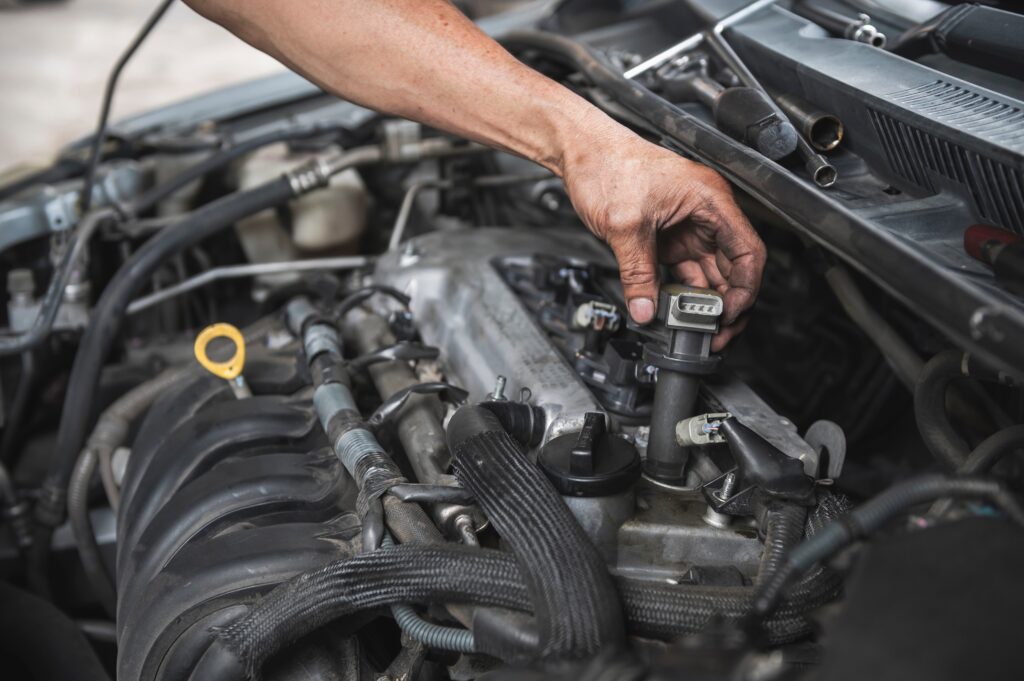
Check the plug on cylinder 1 for wear, fouling, and gap, then the coil boot and terminals for corrosion. Both serve one cylinder, which is why they top the list for a code that names one. Honda makes plug condition a hard gate, instructing technicians to check the spark plug on the affected cylinder and stop if it is clean. [1]
Bad fuel injector & fuel delivery problems
Measure injector resistance and command the injector through the scan tool. A restricted or electrically faulty injector starves one cylinder while the rest run normally, and Toyota requires direct and port injector resistance within specification before any repair applies. [2]
Vacuum leaks & unmetered air
Inspect the intake manifold gasket nearest cylinder 1, along with vacuum hoses and PCV components. A leak at one runner can lean out a single cylinder, and where P0171 appears alongside P0301, the lean condition is usually the parent fault rather than a coincidence.
Low compression & internal engine problems
Run cranking and running compression, then a leakage test if compression is low. Worn valve guides, sticking valves and carbon build-up produce misfire that ignition parts will not fix. GM notes that cold engines may read 0 psi on multiple cylinders, so testing cold can condemn a good engine. [3]
Wiring, sensor & PCM issues
Check the coil and injector connectors for corrosion, trace the harness for chafe points, and confirm current PCM calibration. Damaged wiring can read identically to a failed component, and Honda warns that out-of-sequence repairs result in a full debit of the warranty claim. [1]
How to Diagnose P0301
Start with the swap test, because a cylinder-specific code makes it possible. Moving a coil or injector to another cylinder and watching whether the code follows isolates the fault faster than bench testing individual components.
| Swap result | Conclusion |
| Code follows the coil to another cylinder | Failed coil |
| Code follows the injector | Failed injector |
| Code stays on cylinder 1 | Plug, wiring, compression or injector circuit |
Table 2: What a component swap test reveals on a cylinder-specific misfire.
Scan for P0301 & related trouble codes
Record freeze-frame conditions before clearing anything, since several manufacturer procedures gate on coolant temperature. Check whether P0300 is stored alongside it, because both together mean cylinder 1 has the highest misfire count while others also fail, pointing back to a shared cause.
Inspect & test the spark plug and ignition coil
Read the cylinder 1 plug against the others. A plug that looks substantially different identifies whether the cylinder has an ignition, fuel, oil-control or coolant-entry problem.
Test the fuel injector & fuel delivery
Compare injector resistance against specification and against the other injectors, then command it through the scan tool. Swap it the same way as the coil where the application allows.
Check for vacuum leaks & compression loss
Smoke-test the intake and inspect the manifold gasket nearest cylinder 1, then run compression and leakage testing. Leakage at the exhaust valve points to valve or guide wear rather than rings.
Inspect wiring, sensors & PCM signals
Check connectors for corrosion and trace the harness for chafe points. Confirm current PCM calibration before considering module replacement, which is rarely the cause and always the most expensive assumption.
| Step | Do this | Move on when |
| 1 | Record all codes and freeze-frame data | Conditions noted, especially coolant temperature |
| 2 | Compare the cylinder 1 plug against the others | No fouling or contamination difference |
| 3 | Measure injector resistance and command operation | Resistance in spec, injector responds |
| 4 | Smoke-test the intake near cylinder 1 | No leak found |
| 5 | Run compression, then leakage if low | Compression in spec |
| 6 | Check connectors, harness and PCM calibration | Circuits clean, software current |
Table 3: P0301 diagnostic sequence where the fault stays on cylinder 1.
How to Fix the P0301 Code
Replace only what the testing identified, and correct whatever damaged it at the same time. A component fitted into the same conditions that destroyed its predecessor will fail the same way.
Replace the spark plug & faulty ignition coil
Replace the plug at the specified gap, heat range, and part number, and the coil when the swap test confirms the fault follows it. Correct whatever fouled the plug first, since a fresh plug in a cylinder with an oil or fuel problem fouls again.
Repair or replace the fuel injector
Replace an injector that fails resistance or flow testing. Inspect the harness and connector before assuming the injector itself failed, since a circuit fault reads identically.
Repair vacuum leaks & intake problems
Replace cracked hoses, deteriorated elbows, and failed gaskets rather than sealing over them. Verify the fix by watching fuel trims return to normal range.
Fix compression or internal engine problems
GM specifies upper engine and valve cleaning at 0.5 hours plus an oil change for carbon-related misfire, warning against aftermarket cleaning products and against hydro-locking the engine by inducing cleaner too quickly. [3] Toyota’s repair for cold-temperature misfire on the A25A-FKS engine replaces all eight exhaust-side hydraulic lash adjusters at roughly three hours. [2]
Repair wiring, sensors, or PCM-related faults
Repair chafed wire and corroded terminals rather than splicing around the damage. Update PCM calibration where a bulletin specifies it, and consider module replacement only after every circuit and component test has passed.
| Confirmed fault | Repair | Also do this |
| Spark plug | Replace at specified gap and heat range | Correct whatever fouled it |
| Ignition coil | Replace when the swap test confirms it | Check the boot and connector |
| Fuel injector | Replace on failed resistance or flow test | Inspect harness and connector first |
| Vacuum or intake leak | Replace cracked hoses, elbows, gaskets | Verify fuel trims return to normal |
| Compression loss | Repair per leakage findings | Follow the manufacturer procedure |
| Wiring or connector | Repair the damage; do not splice around it | Secure against the chafe point |
| PCM calibration | Update where a bulletin specifies | Replace the module only after all tests pass |
Table 4: P0301 repairs by confirmed fault.
P0301 Code Repair Cost
Cost depends entirely on which system failed, and the range is unusually wide for a single code. Published labor times from manufacturer bulletins show the scale.
| Repair | Published labor | Coverage |
| PCM reprogram (Ford F-150 5.0L) | 0.3 hr | Emission coverage [4] |
| Upper engine and valve cleaning (GM) | 0.5 hr | Emission coverage [3] |
| Exhaust-side lash adjusters (Toyota) | 2.8 to 3.0 hr | 60 months or 60,000 miles [2] |
| Piston rings (Honda Pilot) | 9.1 hr, plus 1.9 hr if cylinder 4 involved | 8 years, unlimited mileage [1] |
Table 5: Published labor times and warranty coverage for documented P0301 repairs.
Check eligibility before quoting, because on some applications the customer owes nothing. Honda’s coverage follows a class action settlement and excludes vehicles declared a total loss or carrying a branded title. [1] A converter damaged by a deferred misfire adds cost that no warranty covers.
Manufacturer-Specific Causes & Solutions for P0301
Each bulletin below has an applicability gate you must clear before using its procedure. Confirm the VIN, engine, and model year first, because these patterns do not transfer between makes or even between model ranges within a make.
| Make | Bulletin | Gate to clear first | Specified action |
| Toyota | T-SB-0010-24 | Coolant 14–41°F at fault; compression, ignition, injectors, and fuel system all in spec | Replace exhaust-side lash adjusters |
| Chevrolet | 16-NA-383 | Gasoline engine, misfire after 5,000 miles, valve sealing loss | Upper engine and valve cleaning |
| Ford | 23-2011 | 2019–2022 Ranger, misfire codes with water in spark plug wells | Resolve codes, then install engine appearance cover |
| Ford | 26-2011 | 2024–2025 F-150 5.0L built on or before 21 March 2025 | Reprogram the PCM, 0.3 hr |
| Honda | SB 13-082 | 2009–2013 Pilot, iN VIN eligible, plug fouled on affected cylinder | Software and plugs first, then piston rings |
| Nissan | NTB22-069 | 2022 Pathfinder, codes during cold-start warm-up, eligible ECM | Reprogram the ECM |
Table 6: Manufacturer bulletins covering P0301, with applicability gates and repairs.
P0301 on Toyota
A P0301 Toyota concern on recent Camry, RAV4, and Avalon models is temperature-gated. Toyota T-SB-0010-24 applies to the A25A-FKS engine when misfire codes set on cold-soak start-up with coolant between 14°F and 41°F, and only after compression, ignition, injector resistance, and the fuel system all test within specification. [2] Fail any one of those and the bulletin does not apply.
P0301 on Chevrolet
The P0301 code Chevy applications most commonly document is valve deposits rather than an ignition fault. GM bulletin 16-NA-383 covers Buick, Cadillac, Chevrolet, and GMC gasoline engines from 2000 to 2020, and states the misfires should not appear before 5,000 miles, which rules it out on a newer vehicle. [3] SI diagnosis may not isolate the cause, depending on whether the valves stick during the test.
P0301 on Ford
A P0301 diagnosis on Ford splits between a physical cause and a software one. On 2019 to 2022 Ranger models, Ford documents water buildup in the spark plug wells, which corrodes ignition components, and the procedure resolves the codes first, then installs an engine appearance cover to keep water out. [5] Skipping that second step leaves the cause in place.
On 2024 to 2025 F-150 models with the 5.0L engine built on or before 21 March 2025, the same codes can set from PCM software rather than any component fault. [4] For a recent F-150 with misfire codes and no physical findings, a calibration check is recommended before teardown.
P0301 on Honda
A P0301 Honda repair on 2009 to 2013 Pilot models carries an unusually strong warranty position. Piston rings on certain cylinders rotate and align, fouling plugs and setting P0301 through P0304, and American Honda extended powertrain coverage for the condition to eight years with unlimited mileage following a class action settlement. [1]
The order of repair is not optional. On 2009 to 2011 models, the software update and plug replacement must be completed and the vehicle returned before any piston work, and performing ring replacement out of sequence results in a full debit of the warranty claim. [1]
P0301 on Nissan
A P0301 concern on a 2022 Nissan Pathfinder may be software rather than hardware. Nissan bulletin NTB22-069 covers misfire codes during a cold-start warm-up cycle with no drivability concern present, and the ECM part number must match the bulletin list before reprogramming. [6] Complete the specified throttle and idle air volume relearns afterward.
P0301 With Other Trouble Codes
What appears alongside P0301 narrows the search faster than any single test. A code stored on its own points to a component serving cylinder 1, while companion codes usually reveal a larger condition that shows up worst on that cylinder.
Read the combination before choosing a test. Two codes from different systems rarely mean two separate faults, and treating them as unrelated can lead you to replace parts that were only reporting someone else’s problem.
- With P0300: cylinder 1 has the highest misfire count while other cylinders also fail, pointing toward fuel pressure, airflow, or a shared ignition supply.
- With a lean code: an unmetered air or fuel-delivery problem is likely the parent fault, not a coincidence.
- With a catalyst code: the misfire has run long enough to damage the converter, so you need to address both.
- With a coolant temperature code: an engine failing to reach operating temperature affects fuel control, so diagnose P0128 on its own evidence.
How to Prevent P0301 From Returning
Repeat misfire repairs usually fail because the part was replaced without correcting what damaged it. A new plug in a cylinder with an oil consumption problem fouls on the same schedule as the old one.
- Replace plugs at the specified interval and inspect coils, boots, and connectors during scheduled service.
- Check vacuum hoses, PCV components, and manifold gaskets whenever related work brings them into reach, and protect ignition components from water, which is why Ford’s remedy for corrosion-related misfire installs a cover over the spark plug wells rather than only replacing the parts. [5]
- Fuel quality and oil changes shape the conditions behind mechanical misfire, and GM recommends both alongside its diagnostic procedure for carbon-related misfire. [3]
A misfire caught within weeks costs a plug and a coil, while one deferred for months can cost a catalytic converter.
Get the Right Procedure for the Vehicle in Your Bay
Six bulletins, six different applicability gates, and three carrying warranty coverage the customer may be entitled to. Missing either side costs money in opposite directions, through parts that were never needed or warranty work that goes unbilled.
Identifix Direct-Hit® returns the applicable bulletin, wiring diagram, and confirmed fix for the exact VIN, along with the labor times and eligibility criteria that decide what goes on the estimate.
Book a Demo to see how VIN-specific data catches the warranty coverage a generic code lookup never surfaces.
Frequently Asked Questions
Can a P0301 code appear intermittently?
An intermittent P0301 is common and usually indicates a fault that appears only under specific conditions. Temperature is the most frequent variable, with Toyota documenting a misfire that appears only when coolant sits between 14°F and 41°F at start-up. [2] Record freeze-frame data rather than clearing the code, since the conditions it captured are what make the fault reproducible.
Can P0301 be caused by bad or low-quality fuel?
Fuel quality contributes to the deposits that cause misfire over time. GM attributes valve carbon build-up partly to fuel contamination or incomplete burning and recommends higher-quality fuel and regular oil changes as both preventive measures and diagnostic steps. [3] Fuel alone rarely causes a sudden single-cylinder misfire, but it shapes the conditions that lead to one.
Why does P0301 come back after replacing the spark plug?
A returning P0301 means the plug was a symptom, not the cause. Oil consumption, coolant entry, a failing injector, or compression loss will foul a new plug as quickly as the old one. Honda’s procedure for affected Pilot models reflects this directly, treating a second failure after plug replacement as the trigger for piston ring work. [1]
Can a P0301 code cause a car to fail an emissions test?
A stored misfire code will cause a vehicle to fail an OBD-based emissions inspection in jurisdictions that read the onboard system. Clearing the code before testing does not help either, because the readiness monitors reset and must run to completion before the vehicle can pass.
Can cold starts trigger a P0301 misfire?
Cold starts are a documented trigger on several applications. Toyota’s bulletin for the A25A-FKS engine gates entirely on coolant temperature between 14°F and 41°F at start-up [2], and Nissan documents misfire codes appearing specifically during a cold-start warm-up cycle on the 2022 Pathfinder. [6] A misfire that disappears once warm is a clue, not a reason to dismiss the code.
References
- American Honda Motor Co., Inc. (2022, July 19). Warranty extension: MIL comes on with DTCs P0301 thru P0304 (Service Bulletin 13-082, Version 12). National Highway Traffic Safety Administration.
- Toyota Motor Sales, U.S.A., Inc. (2024, February 21). MIL ON with misfire DTC(s) in cold temperatures (T-SB-0010-24). National Highway Traffic Safety Administration.
- General Motors LLC. (2020, May). Information on rough idle, crank no start, extended crank or misfire due to excessive carbon on top of valves or sticking valves (Service Bulletin 16-NA-383). National Highway Traffic Safety Administration.
- Ford Motor Company. (2026, January 22). Illuminated MIL with DTCs P0300, P0316, and/or P0301 through P0308 (Technical Service Bulletin 26-2011). National Highway Traffic Safety Administration.
- Ford Motor Company. (2023, January 13). Illuminated MIL with misfires DTCs/water in spark plug wells and/or corrosion on ignition system components (Technical Service Bulletin 23-2011). National Highway Traffic Safety Administration.
- Nissan North America, Inc. (2022, August 15). Misfire DTCs stored in the ECM during cold start (NTB22-069). National Highway Traffic Safety Administration.

Identifix is the leading provider of automotive repair shop solutions and sevices designed to improve shop profitability and repair outcomes.