
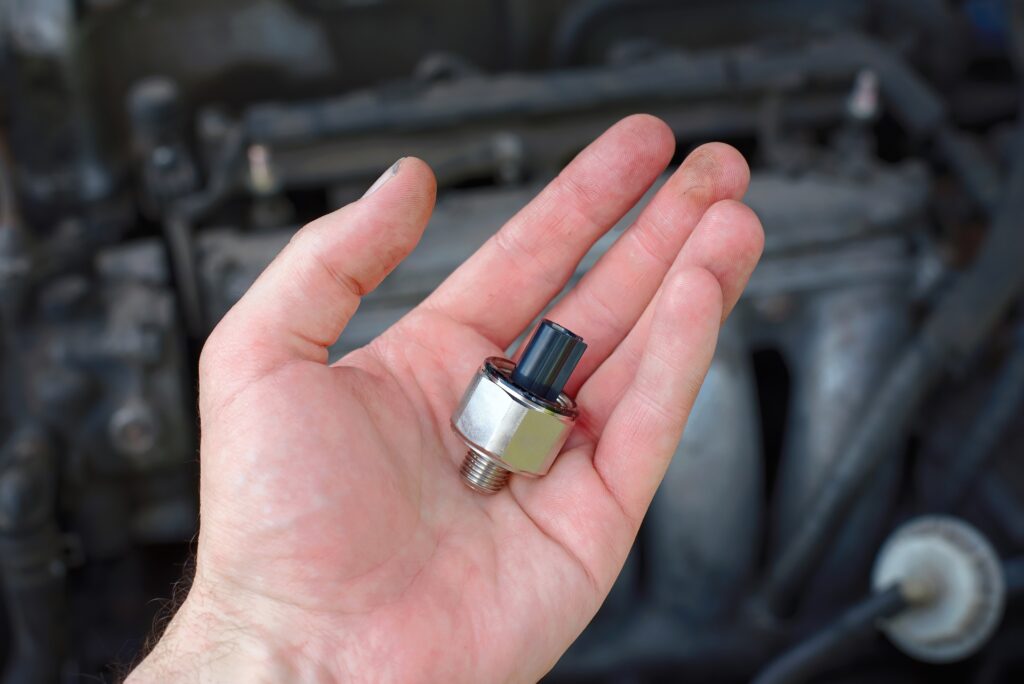
Key Takeaways
- P0332 indicates the PCM detects a low voltage in the Bank 2 knock sensor circuit. The sensor cannot report knock; it does not mean the engine is knocking.
- Only V-type and horizontally opposed engines can set P0332, since an inline engine has just one bank.
- On GM LS-series V8s, water pools in the engine valley under the intake manifold and corrodes the sensors and connectors.
- Test resistance against the manufacturer’s specification. GM LS sensors typically read 93-107 kω, not infinite.
- Sealing the sensor cavity matters as much as the part. A new sensor in a wet valley fails again.
Diagnostic Trouble Code (DTC) P0332: Knock Sensor 2 Circuit Low Input (Bank 2) indicates that the powertrain control module (PCM) detects a lower voltage output than expected from the second knock sensor in the engine’s second bank.
While this low-voltage signal points to an issue with the knock sensor or its wiring and connections, it can also mean the knock sensor can’t alert the PCM to actual knock if it occurs. Severe knocking gone undetected can put the engine at risk of premature failure.
The comprehensive guide below explores the symptoms and causes commonly associated with DTC P0332, then outlines the diagnostic and repair steps to resolve any existing issues.
Please note that this information is neither exhaustive nor explicitly tailored to a particular make, model, or model year, although this trouble code is often found on LS-series engines for the reasons detailed below.
What Does DTC P0332 Mean?
A P0332 code signals that the knock sensor in Bank 2 isn’t functioning as expected. Each bank relies on a separate knock sensor to detect conditions such as pre-ignition and detonation, which can lead to severe internal engine damage if left unaddressed. Pre-ignition refers to ignition of the air-fuel mixture before the spark plug fires, while detonation is the uncontrolled combustion of this mixture.
If the knock sensor detects engine knock, it alerts the PCM to retard timing. Only after the knock ceases will the PCM return timing to normal.
When the knock sensor’s voltage falls outside the manufacturer-specified range, it fails to deliver the necessary feedback to the PCM, and the P0332 engine code sets. The distinction matters: the code reports a circuit fault, not an active knock event.
Bank 2 is the second cylinder bank, so only a V-type or horizontally opposed engine can set this code. An inline engine has one bank and will use the Bank 1 codes instead. The table below shows where P0332 sits among the knock sensor circuit codes.
| Code | Sensor | Bank | Fault |
| P0327 | Knock sensor 1 | Bank 1 | Circuit low |
| P0328 | Knock sensor 1 | Bank 1 | Circuit high |
| P0332 | Knock sensor 2 | Bank 2 | Circuit low |
| P0333 | Knock sensor 2 | Bank 2 | Circuit high |
P0327 and P0332 frequently appear together, suggesting a shared harness or connector rather than two sensors failing simultaneously.
Common Symptoms of Code P0332
A check engine light is the most common symptom, and on many vehicles it is the only one. When other symptoms appear, they usually reflect the conservative timing the PCM applies once it loses knock feedback.
Check engine light
A steady malfunction indicator lamp is the primary symptom. Retrieve the code with a scan tool and record any companion codes before clearing anything, since P0327 often appears alongside it.
Engine knocking or pinging
Audible knock under load is a separate condition from the code itself. If you hear a metallic rattle during acceleration, towing, or climbing a grade, the engine is detonating and needs attention regardless of the sensor’s state.
Reduced engine performance
Without usable knock feedback, the PCM retards timing by default. The result is noticeably less power under load, which owners often describe as the vehicle feeling sluggish.
Poor fuel economy
Retarded timing lowers combustion efficiency and raises emissions, which is why an unresolved fault can fail an inspection alongside a catalyst code such as P0420. The economy drop itself is usually modest and should be treated as supporting evidence rather than proof of a knock sensor fault.
Engine hesitation or rough running
Hesitation on acceleration can accompany the timing default, but it also points to ignition faults such as P0352. Confirm which codes are stored before attributing a drivability complaint to the knock sensor circuit.
What Can Cause a DTC P0332?
A P0332 code can occur in any engine with two banks and two corresponding knock sensors. However, it’s most common on Chevrolet’s LS-series V8 engines. An unfortunate design flaw in the engine’s shape allows water to pool beneath the intake manifold and around the knock sensor.
Common causes of DTC P0332 also include the following:
- Faulty knock sensor.
- Poor electrical connection at the knock sensor.
- Open or shorted knock sensor wiring.
- Corroded or damaged harness and connectors.
- Moisture or condensation in the sensor cavity.
Moisture deserves its own mention because it can set the code without a failed part. Maserati’s service documentation notes that cold or humid conditions can trigger P0327, P0332, and related knock-sensor circuit codes due to condensation alone, and directs technicians to perform a warm-up burn-off procedure before replacing components. [1] The same mechanism explains the LS-series pattern, where water collects in the valley rather than condensing there.
A separate group of conditions causes actual detonation rather than a circuit fault. Exhaust gas recirculation (EGR) problems, a lean air-to-fuel ratio, and cooling system faults can all cause an engine to knock.
They do not set P0332, but they explain why unreported knock matters: with the Bank 2 sensor offline, the PCM never learns the engine is detonating. Rarely, a faulty powertrain control module causes the circuit fault itself.
How to Diagnose P0332 Code
Diagnosing DTC P0332 requires gathering information about various electrical and mechanical components related to the engine’s two knock sensors. A thorough diagnosis is vital to ensuring you’ve resolved the problem, at least for the foreseeable future. Below are the basic steps involved in diagnosing a P0332 code. The table below summarizes what each test result points to.
| Reading | Indicates |
| Resistance within specification | Sensor likely good; check harness and connector |
| Resistance far outside specification | Failed sensor |
| Open circuit at the sensor | Failed sensor or broken wire |
| Open at PCM connector, good at sensor | Harness fault between sensor and module |
| Resistance in spec, no signal on tap test | Failed sensor despite normal resistance |
Scan for additional codes
Starting with an OBD-II scan tool can help you pinpoint the cause of a P0332 code. As you check for this code, scan for related codes that can provide additional insight. If any correspond to another system, add that to your diagnostic to-do list after you’ve inspected the knock sensor. Record freeze-frame data as well, since a fault that appears only in cold or damp conditions points toward moisture rather than a failed sensor.
Note any emissions codes stored alongside it, because they block inspection readiness independently of the knock sensor circuit. An EVAP fault, such as P0442 in a gasoline application, or an aftertreatment code, such as P20EE in a diesel, will keep the vehicle from passing even after you verify the knock sensor repair.
Visually inspect the knock sensor wiring and connections
A visual inspection can uncover faulty wiring or connections that prevent the knock sensor from communicating effectively with the PCM. Inspect the sensor body, connector, and wiring for signs of corrosion or damage. Improper installation and a loose connection can also contribute to a P0332 code. On GM V8 applications, check the two-wire knock sensor harness connector near the rear of the intake manifold, which is a common failure point when both P0327 and P0332 are stored.
Verify knock sensor voltage and resistance
With the key in the ON position and the connector unplugged, measure voltage across the two sensor circuits identified in the wiring diagram for that application.
Do not rely on wire colors from another vehicle, since they vary by make and model year. A reading at the expected reference voltage confirms the PCM side of the circuit is intact. It does not confirm the sensor is good.
Then measure resistance across the sensor terminals and compare it to the manufacturer’s specification. GM LS-series knock sensors typically read 93-107 kω. A reading far outside that window, or an open circuit, indicates a failed sensor or a broken harness. Testing at the PCM connector rather than at the sensor confirms whether the fault lies in the sensor or the wiring between them.
Check knock sensor signal
A knock sensor is a passive piezoelectric device that generates its own AC voltage when the block vibrates. Rather than looking for a supply voltage, tap the block near the sensor with a small hammer while watching for AC output on a meter or oscilloscope, or watch knock retard respond on the scan tool. A sensor that produces no signal under a controlled tap has failed even if its resistance falls within range.
Test the circuit at the ECM
If the sensor and its connector test correctly, move to the module end. Check for continuity and resistance between the sensor connector and the corresponding PCM pins, and inspect the module connector for corrosion or water intrusion. Confirm the circuit is faulty before considering the PCM, since module replacement requires programming and is rarely the cause.
How to Fix the P0332 Code
The right repair depends on the test results. Component replacement resolves most cases, but the repair holds only if you also correct the condition that damaged the part.
Replace the faulty knock sensor
Replace the sensor when resistance falls outside specification, or it produces no signal under a controlled tap. Use the part specified for the application and torque it to the manufacturer’s figure, since a loose or over-torqued sensor can set the code on its own.
Repair damaged wiring or connections
Repair or replace corroded terminals, chafed wire, and damaged connectors. On engines where the sensors sit under the intake manifold, replace the harness at the same time as the sensor rather than reassembling around a connector you cannot reach again without repeating the job.
Fix underlying engine problems
If audible knock is present, address its cause separately. EGR faults, lean operation, overheating, and incorrect fuel grade all produce detonation that a working sensor would report. Repairing the circuit restores the warning; it does not stop the knock.
Repair or replace the ECM
Consider the module only after the sensor, wiring, connectors, and grounds test correctly. Check the module connector gaskets for water intrusion first, and confirm whether a calibration update applies before replacing hardware.
Clear the code and verify the repair
Clear the code, then operate the vehicle under load so the knock sensor monitor can run. Confirm that no pending codes are returned and that knock retard responds normally on the scan tool. A cleared lamp on its own does not prove the repair worked.
Repairing the Underlying Cause of DTC P0332
Replacing the knock sensor may seem like the obvious solution for a DTC P0332, but it doesn’t always address the root cause. Instead, thoroughly diagnose and repair or replace any malfunctioning or broken components, including the knock sensor wiring or connectors. If you replace the knock sensor, replace the harness at the same time.
Should you uncover additional underlying causes, address those before ensuring every repaired or replaced component functions properly. Clear any codes before taking a test drive to confirm the issue is resolved.
This is where repeat failures come from. On engines with the sensors mounted in a valley beneath the intake manifold, a new sensor installed into a cavity that still collects water will corrode the same way.
Seal the sensor cavities and remove anything that traps moisture against the connectors before reassembly. A repair that replaces the part without correcting the environment brings the vehicle back.
P0332 Chevy: Causes, Diagnosis & Repair
The P0332 code Chevy owners encounter most often traces to a design characteristic rather than to sensor quality. On LS-based V8s, both knock sensors sit in cavities in the engine valley, directly beneath the intake manifold. Rain, washing, and condensation collect in those pockets, submerging the sensors and their connectors and causing corrosion at the terminals and inside the sensor body.
Bank 2 is the rear sensor, nearer the firewall. Access requires removing the intake manifold, so plan the job around a single disassembly rather than expecting to return to it.
A P0332 Chevy Silverado diagnosis should start with the assumption that moisture is involved until the valley proves dry. Inspect both sensors and the shared harness during the teardown, and measure the resistance against the 93-107 kω specification before reassembly.
Replacing only the sensor that set the code is a common shortcut that results in a second visit, and when the intake is already off, the labor to address both sides is minimal.
Seal the sensor cavities and remove anything that traps moisture against the connectors before reinstalling the manifold. A P0332 Chevy Silverado repair that renews the part without correcting the environment brings the truck back.
P0332 GM: Causes, Diagnosis & Repair
A GM P0332 concern follows the same pattern across every truck and SUV sharing the LS platform, including Sierra, Tahoe, Suburban, Yukon, and Escalade. Inspect for water, test resistance at the sensor and at the module connector, then seal before reassembly.
Two things separate a GM P0332 diagnosis from the Chevrolet-specific case above. When P0327 and P0332 are both stored, suspect the shared two-wire harness connector near the rear of the intake manifold rather than two sensors failing simultaneously. And not every GM knock sensor code is due to valley corrosion, since newer four-cylinder applications use different sensor circuits and have their own calibration-related bulletins.
Confirm the engine family and model year before applying the LS assumption. A calibration fault and a corroded connector can look identical on a scan tool but differ in every other way.
For the most detailed diagnostic and repair steps, consult Identifix Direct-Hit® to access deeper test-plan details and thorough diagnostic resources designed to streamline repairs.
FAQs
Where is the knock sensor for P0332 located?
P0332 refers to the Bank 2 sensor, on the side of the engine that does not contain cylinder number one. Location varies by design. On GM LS-series V8S, both sensors sit in the engine valley beneath the intake manifold, with Bank 2 toward the firewall. Other engines mount them externally on the block, where access is far easier.
Can a bad knock sensor cause P0332?
Yes, but it is not the only cause. A failed sensor, a corroded connector, damaged wiring, moisture in the sensor cavity, or a circuit fault at the module can all produce a low-voltage signal. Test the circuit before replacing the sensor, since a good sensor on a corroded connector reads the same as a bad one.
Can P0332 cause engine damage?
Not directly. The risk is indirect. With the Bank 2 sensor offline, the PCM cannot detect detonation on that bank and cannot retard timing in response. Most modules apply a conservative default timing calibration to compensate. The risk comes from sustained heavy load with undetected knock.
Can I drive with the P0332 code?
You can usually drive a vehicle with P0332 alone to a shop. The code means the sensor cannot report knock, not that the engine is knocking. The PCM defaults to retarded timing, which protects the engine but reduces power and fuel economy. Stop driving and seek service if you hear an audible knock or pinging under load, as that is a separate condition requiring immediate attention.
How much does it cost to fix P0332?
Cost depends almost entirely on sensor location. On an engine with externally mounted sensors, the part is inexpensive, and the labor is short. On an LS-series V8, the intake manifold has to come off, which turns a low-cost part into several hours of work. Because the teardown dominates the bill, replacing both sensors and the harness during the same job is usually the better value.
References
- Maserati North America, Inc. (2025, July 31). Knock sensor moisture burn-off procedure. National Highway Traffic Safety Administration. https://static.nhtsa.gov/odi/tsbs/2025/MC-11021166-0001.pdf
Identifix is the leading provider of automotive repair shop solutions and sevices designed to improve shop profitability and repair outcomes.