
Key Takeaways
- P0174 means the PCM added fuel past its correction limit on Bank 2, the cylinder bank that does not contain cylinder 1.
- Only V-type and flat engines set this code. An inline four has one bank and cannot trigger it.
- Fuel trims that spike at idle and normalize at 2,500 RPM point to a vacuum leak, not a fuel issue.
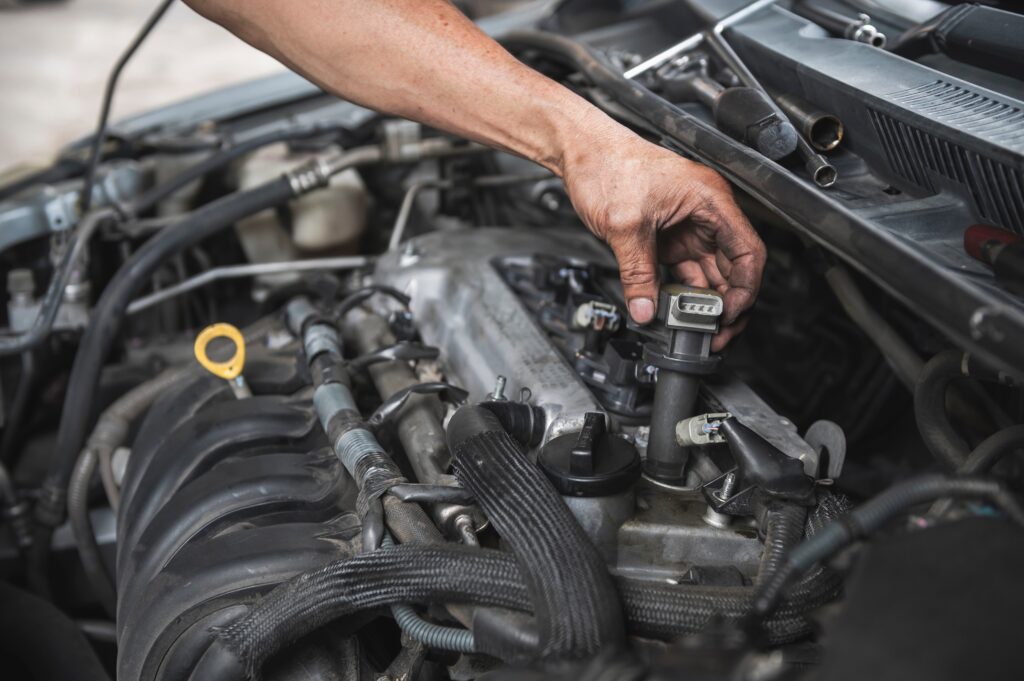
What Does the P0174 Code Mean? Everything You Need to Know for a Quick Diagnosis
P0174 means the powertrain control module (PCM) detected a lean air-fuel mixture on Bank 2 and reached the limit of how much fuel it can add to compensate. The upstream sensor reports excess oxygen, the PCM increases injector pulse width, and when long-term fuel trim stays well past normal across the monitor, the code sets.
Bank 2 is the side of the engine that does not contain cylinder 1, which immediately narrows the vehicle population.
| Engine type | Banks | Can set P0174? |
| Inline 4 or inline 6 | One | No |
| V6 or V8 | Two | Yes |
| Flat or horizontally opposed | Two | Yes |
Table 1: Engine configurations that can set P0174.
Confirm which physical side is Bank 2 from the firing order before testing. Most makes split odd and even cylinders across banks, but Ford numbers sequentially, which puts Bank 2 on the opposite side from what a technician used to other makes would expect. P0171 is the same fault on Bank 1, and together the codes usually point to a shared cause rather than two separate faults.
Severity is the reason not to defer it. A lean mixture burns hotter than a proper one, stressing pistons, valves, and spark plugs, while unburned fuel from a lean misfire overheats the catalytic converter and can set a code such as P0420, turning a hose repair into a converter replacement. Forced induction engines and vehicles under load are least tolerant of deferral.
P0174 Code Symptoms
Symptoms depend on how lean the mixture runs and when. Many vehicles show nothing but a check engine light, particularly early on. The sections below cover what appears as the condition worsens.
Check engine light and rough idle
A steady check engine light is often the only symptom a driver notices, with rough idle following because a vacuum leak has its greatest proportional effect at low airflow. At idle, the engine draws little air, so an unmetered leak represents a larger share of intake volume and becomes almost invisible at highway speed.
Engine misfires, hesitation and stalling
A sufficiently lean mixture fails to ignite reliably, producing misfire codes such as P0300 alongside the lean code. Hesitation appears on throttle tip-in when the PCM cannot add fuel fast enough, and stalling at stops means it can no longer hold idle against the leak.
Loss of power and poor acceleration
Power drops under load because the engine isn’t getting the fuel it needs for the air entering it, and the driver compensates with more throttle, which widens the gap. Forced induction engines show this more sharply, since boost multiplies the airflow the PCM is already failing to fuel correctly.
Reduced fuel economy
Economy falls despite the engine running lean, which seems contradictory until you account for compensation. The PCM continuously adds fuel to correct the imbalance while the driver adds throttle to recover lost power.
Hard starting and other drivability problems
Extended cranking is common when the leak is large enough to affect the initial start, and symptoms often worsen in cold weather. Cold air is denser, which deepens the lean condition before the engine reaches closed loop and the PCM begins trimming.
| Symptom | When it shows | Points toward |
| Check engine light only | Any time, often the only sign | Leak too small to feel |
| Rough or unstable idle | At idle, improves with RPM | Vacuum leak |
| Misfire, hesitation, stalling | Throttle tip-in, at stops | Mixture lean enough to fail ignition |
| Power loss under load | Acceleration, towing, grades | Fuel delivery or large unmetered leak |
| Hard starting | Cold starts, worse in winter | Large leak or fuel pressure |
Table 2: P0174 symptoms and what each points toward.
Common Causes of P0174
The P0174 engine code has one dominant cause and several secondary ones. Unmetered air entering after the mass airflow sensor is the cause identified in four of the six manufacturer bulletins referenced in this article, followed by airflow measurement errors and fuel delivery shortfalls.
| Category | Typical faults |
| Unmetered air | PCV tube, intake gasket, vacuum hose, brake booster, purge valve |
| Airflow measurement | Contaminated or biased MAF, skewed MAP, air bypassing the sensor |
| Fuel delivery | Weak pump, restricted filter, low rail pressure, faulty injectors |
| False lean signal | Exhaust leak ahead of the sensor, slow or biased O2 sensor |
| Software | Outdated PCM calibration |
Table 3: P0174 causes grouped by system.
Vacuum leaks and unmetered air
Start at the PCV tubes and elbows, intake manifold gaskets, brake booster hose, throttle body gasket, and EVAP purge valve. Air entering downstream of the MAF is never measured, so the PCM under-fuels for the airflow actually reaching the cylinders.
GM documents the engine cover rubbing through the PCV tube at the left rear of the intake manifold on V8 trucks and SUVs, and specifies sleeving the replacement in conduit to prevent recurrence. [1]
Dirty MAF sensor and intake problems
Inspect the MAF sensing element, air filter seating, intake boot, and clamp tightness between the sensor and throttle body. A contaminated MAF under-reports airflow, and the PCM fuels for the smaller number it receives, which looks identical to a vacuum leak in the trim data.
Contamination usually traces to an air filter seated poorly enough to let unfiltered air past it.
Low fuel pressure and fuel delivery issues
Measure commanded versus actual rail pressure, pump supply voltage, and fuel volume under load, not at idle. Insufficient fuel produces the same lean reading as excess air, because the PCM sees the outcome rather than the cause.
Toyota makes this a hard gate, directing technicians to verify pressure with a manual gauge before the fuel pump path engages. [2]
Clogged fuel injectors and restricted fuel filter
Test injector operation through scan-tool controls, current ramping, or pressure-drop testing, then assess the serviceable filter. Restricted injectors reduce delivered volume without setting a circuit code, so nothing in the scan data points directly at them.
Deposits build gradually, which is a useful clue when the customer reports no single triggering event, and you should replace a restricted filter rather than clean it.
Faulty oxygen sensors, exhaust leaks, and PCV/EVAP problems
Start on the exhaust side, checking manifolds, gaskets, and flex joints ahead of the Bank 2 sensor before moving to sensor response and purge valve operation. These causes all make a healthy bank report lean, since a leak ahead of the upstream sensor draws outside air into the stream even when that bank is running rich. Nissan addresses this directly, instructing technicians to replace the air-fuel ratio sensor only when a confirmation test sets P2096 through P2099. [3]
How to Diagnose P0174
Diagnosing P0174 means finding why Bank 2 needs excessive positive fuel correction. Work from scan data toward physical testing, because fuel trim behavior narrows the search before anything comes apart.
| Trim pattern | Points toward |
| High positive at idle, normalizes by 2,500 RPM | Vacuum leak |
| Positive across the whole range | MAF, MAP, or fuel delivery |
| Bank 2 only | Bank-specific leak, sensor, or exhaust leak |
| Both banks positive | Shared cause: MAF, fuel pressure, PCV, intake |
Table 4: Fuel trim patterns and what they indicate.
Scan for P0174 and related trouble codes
Record every stored, pending, and permanent code with freeze-frame data before clearing anything, noting whether the code appears cold, at idle, or under load. Check whether P0171 is stored alongside it, and if P0128 is also present, diagnose the coolant temperature issue on its own evidence rather than assuming it caused the lean condition.
Check short-term and long-term fuel trim
Compare Bank 1 and Bank 2 trims at idle and at a steady 2,500 RPM, since trims positive at idle that normalize as speed rises indicate a vacuum leak while trims positive across the range point to measurement or fuel delivery. GM turns this into a test on 3.6L applications: record both trims at operating temperature, then disconnect and plug the foul air tube and restart. If trims were positive above 5 and short-term now swings consistently negative, the foul air tube is the leak. [4]
Inspect for vacuum, intake, and exhaust leaks
Inspect intake ducting, manifold gaskets, PCV components, brake booster lines, and purge plumbing, checking every point where a tube routes against another component and can chafe. On the exhaust side, check ahead of the Bank 2 upstream sensor, since a leak behind the downstream sensor is unlikely to explain the code.
Test the MAF sensor, oxygen sensors, and fuel pressure
Compare MAF output against known-good values under the same conditions and check the MAP signal against barometric pressure with the key on and engine off. Verify sensor response by commanding controlled rich and lean conditions, and measure fuel pressure and volume under load rather than at idle.
Perform a smoke test and confirm the fault
Smoke-test the intake when inspection and data have not located the leak, following the equipment maker’s pressure limits. After repair, clear the code, complete the applicable drive cycle, and confirm trims return to normal range with no pending code.
| Step | Do this | Move on when |
| 1 | Record all codes and freeze-frame data | Conditions noted, including whether cold or under load |
| 2 | Compare Bank 1 and Bank 2 trims at idle and 2,500 RPM | Pattern identified against Table 4 |
| 3 | Inspect intake, PCV, booster, and purge plumbing | No leak found visually |
| 4 | Test MAF and MAP against known-good values | Readings in spec |
| 5 | Measure fuel pressure and volume under load | Pressure holds in spec |
| 6 | Smoke-test the intake | No leak found |
Table 5: P0174 diagnostic sequence.
Manufacturer-Specific Causes & Solutions for P0174
The code definition is standardized, but the likely cause, the applicable bulletin, and the correct repair vary by make. Confirm the VIN, engine, and model year before applying any pattern below, since model-year coverage differs within a single bulletin.
| Make | Bulletin | Applies to | Specified action |
| Chevrolet, GMC | PIP5341 | V8 trucks and SUVs, 2007–2013 to 2007–2016 by model | Replace rubbed-through PCV tube, sleeve in conduit |
| Chevrolet, GMC | PIP5549A | 3.6L applications, 2012–2019 by model | Foul air tube isolation test, then purge valve test |
| Chevrolet, GMC | 17-NA-391 | Colorado and Canyon 2017–2020, LGZ | Inspect PCV fresh air tube, then foul air tube |
| Chevrolet, GMC | 21-NA-105 | Colorado and Canyon 2020–2021, LGZ | Reprogram the ECM, 0.3 hr |
| Toyota | T-SB-0009-23 | 2014–2020, with fuel pressure out of spec | Replace the fuel pump |
| Nissan | NTB19-022 | Confirmation procedure sets P2096–P2099 | Replace the A/F sensor; otherwise, exclude it |
Table 6: Manufacturer bulletins, applicability, and specified repairs.
P0174 on Chevrolet
A P0174 code Chevy technicians see on full-size trucks traces to the engine cover rubbing through the PCV tube, covered by PIP5341 for Silverado, Avalanche, Tahoe, Suburban, and Silverado HD with the 4.8L, 5.3L, 6.0L, or 6.2L V8. [1] Model year coverage differs by model, running 2007 to 2013 on Silverado and Avalanche, to 2014 on Tahoe and Suburban, and to 2016 on Silverado HD.
On 3.6L applications, the pattern differs. PIP5549A provides a two-stage test that isolates the foul air tube first and the purge valve second, and GM is explicit that a P0174 code Chevy repair should replace the intake manifold only if that test actually moved the fuel trims. [4]
P0174 on Ford
A P0174 Ford diagnosis splits between mechanical and software causes. Ford service information documents deteriorating intake manifold port gaskets and isolator bolt assemblies on the 4.0L SOHC V6, and the PCV hose elbow at the rear of the intake manifold is a known failure point across the modular V8 range, both sitting where a visual inspection misses them.
PCM software is the second path and easy to overlook, with multiple bulletins noting that lean codes can set from calibration level rather than any physical fault, including one addressing flex-fuel learning errors caused by frequent small refuels. A P0174 Ford concern on a late-model vehicle with normal-looking fuel trims warrants a software check before teardown.
P0174 on Toyota
A P0174 Toyota diagnosis should address fuel delivery early. T-SB-0009-23 covers 2014 to 2020 applications with a hard start or MIL and P0171, P0174, or P0087 stored, applying a two-stage gate: review Techstream data for positive fuel trims, then verify fuel pressure with a manual gauge. [2] If pressure is within specification, the bulletin does not apply; if it is out of specification, the specified repair is fuel pump replacement.
P0174 on Nissan
A P0174 Nissan diagnosis starts with the air-fuel ratio sensor, but not by replacing it. NTB19-022 directs technicians to run the confirmation procedure first and replace the sensor only if it sets P2096 through P2099; otherwise, continue diagnosis while excluding it. [3] That carries a cost, since Nissan places parts replaced under warranty for these codes on automatic return for inspection and charges back any found functional, which is exactly what a P0174 Nissan repair that swaps on suspicion runs into.
P0174 on GMC
Sierra and Yukon share the V8 PCV tube rub-through pattern with their Chevrolet equivalents, with Sierra covered to 2015 and Sierra HD to 2016. [1]
On Canyon, the cause depends on the model year. 17-NA-391 directs technicians to the PCV fresh air tube at the air cleaner outlet duct first on 2017 to 2020 Colorado and Canyon, where reconnecting a disconnected tube completes the repair with no parts, and GM allocates 0.2 hours for that check against 2.5 hours to reach the foul air tube behind the rear noise shield. [5] For 2020 to 2021 models, 21-NA-105 attributes lean codes on vehicles under 1,800 miles to software anomalies and directs an ECM reprogram regardless of what the visual inspection finds, making a near-new Canyon a software check rather than a smoke test. [6]
How to Fix the P0174 Code
The repair follows the confirmed cause. Each fix below assumes testing has isolated the fault rather than pointing at the most familiar part.
Repair vacuum, intake, and exhaust leaks
Replace cracked hoses and failed gaskets rather than sealing over them, and protect any chafed run before reassembly. [1] Repair exhaust leaks ahead of the upstream sensor first, since a leak there makes a working sensor report lean.
Clean or replace the MAF sensor
Clean the element only where the manufacturer permits, and only with an approved product. Correct whatever contaminated it, usually a poorly seated air filter, since a new sensor behind the same gap fails the same way.
Repair PCV and EVAP system problems
Replace failed PCV components and test the purge valve for a stuck-open condition. These inexpensive parts can cause expensive diagnoses when missed, which is why GM’s 3.6L procedure tests them before anything else. [4]
Clean or replace fuel injectors and restore fuel pressure
Restore rail pressure by addressing the pump, regulator, filter, or driver module as testing indicates. Replace restricted injectors rather than relying on additives, which are not a substitute for testing a confirmed fault.
Replace faulty oxygen sensors and clear the code
Replace the upstream sensor only after you’ve verified its response and circuit and ruled out an exhaust leak. Clear the code, complete the drive cycle, and confirm fuel trims stabilize before returning the vehicle.
| Confirmed fault | Repair | Also do this |
| Vacuum or intake leak | Replace cracked hoses, elbows, gaskets | Sleeve any run that chafed |
| Contaminated MAF | Clean if permitted, otherwise replace | Correct the air filter seating |
| PCV or purge fault | Replace the component, test purge operation | Retest trims after repair |
| Low fuel pressure | Address pump, regulator, filter, or driver module | Verify under load, not at idle |
| Exhaust leak | Repair ahead of the upstream sensor | Re-evaluate sensor data afterward |
| Biased O2 sensor | Replace after circuit and response testing | Rule out an exhaust leak first |
Table 7: P0174 repairs by confirmed fault.
How to Prevent P0174 From Returning
Most repeat P0174 repairs fail for the same reason. The part was replaced, but the condition that damaged it was not corrected.
- Protect chafe points: Sleeve any tube that contacts another component during reassembly. [1]
- Seat the air filter correctly: Unfiltered air is what contaminates MAF sensors.
- Replace deteriorating PCV components: Do it at service rather than waiting for a code.
- Check calibration status: Verify software level on late-model vehicles before assuming a mechanical cause. [6]
- Verify the repair: Complete a full drive cycle rather than relying on a cleared lamp.
Get the Right Procedure for the Vehicle in Your Bay
Six bulletins, six different applicability gates, and a 0.2-hour check that resolves what a 2.5-hour teardown would otherwise chase. Applying the wrong one costs either a part that did not need replacing or hours spent reaching a connection that was never the problem.
Identifix Direct-Hit® returns the applicable bulletin, wiring diagram, and confirmed fix for the exact VIN, along with the labor times that decide what goes on the estimate. Book a Demo to see what that does to your diagnostic time.
Frequently Asked Questions
What is the most common cause of P0174?
Manufacturer bulletins identify unmetered air entering after the mass airflow sensor as the most common cause. Cracked PCV tubes, deteriorated intake gaskets, failed vacuum hoses, and purge valves stuck open account for a large share of cases. Fuel trims that are strongly positive at idle and normalize at higher engine speeds point to a leak, not a bad MAF.
Can a dirty MAF sensor, vacuum leak, or bad oxygen sensor cause P0174?
All three can, but they produce different signatures. A vacuum leak affects idle most and improves with RPM, while a contaminated MAF skews trims across the whole range. A biased oxygen sensor or an exhaust leak ahead of it reports lean when the bank may actually be running rich. Test each rather than replacing in sequence.
Can I drive with P0174, and can it damage the engine?
Short trips at light load are usually tolerable, but a lean mixture burns hot and sustained heat causes damage. Unburned fuel from a lean misfire can also overheat the catalytic converter. Avoid high load, high RPM, and towing, and treat forced-induction engines as less tolerant of deferral.
How do I fix code P0174 and how much does it cost?
Repair the cause the testing identified, because the range is wide. A disconnected PCV tube costs almost nothing beyond the 0.2 hours GM allocates to inspect it, [5] while a fuel pump, injectors, or a damaged catalytic converter run considerably higher. Quote after the diagnosis, not from the code.
Will P0174 clear itself, or can resetting the ECU fix it?
The lamp may switch off after the monitor passes on several consecutive trips, but that does not confirm the cause is repaired. Resetting the ECU erases freeze-frame data you need and does not address a physical leak. On specific late-model applications, an ECM reprogram is the documented repair, though that is a calibration update rather than a reset. [6]
References
- General Motors LLC. (2015, October). SES lamp P0171 P0174 (Preliminary Information PIP5341). National Highway Traffic Safety Administration.
- Toyota Motor Sales, U.S.A., Inc. (2023, February 9). Fuel pump (loss of fuel pressure) (T-SB-0009-23). National Highway Traffic Safety Administration.
- Nissan North America, Inc. (2019, March 5). Nissan: P0171 and P0174 service information (NTB19-022). National Highway Traffic Safety Administration.
- General Motors LLC. (2019, May 7). Diagnostic tip: SES light is on with DTCs P0171 and/or P0174 set (Preliminary Information PIP5549A). National Highway Traffic Safety Administration.
- General Motors LLC. (2020, February). Diagnostic tip for malfunction indicator lamp (MIL) illuminated: DTC P0171 P0174 set (Service Bulletin 17-NA-391). National Highway Traffic Safety Administration.
- General Motors LLC. (2021, May). Engine control module calibration for DTC P0171 and P0174 set (Service Bulletin 21-NA-105). National Highway Traffic Safety Administration.

Identifix is the leading provider of automotive repair shop solutions and sevices designed to improve shop profitability and repair outcomes.