
Recognizing and understanding common dashboard lights is an essential part of safely operating a vehicle, just as important as learning how to parallel park, execute three-point turns, and merge onto the highway. Most vehicles incorporate multiple dashboard lights into the gauge cluster, many of which are displayed in various colors that correspond to specific meanings. If you encounter an unfamiliar blue light on your dashboard, knowing what to do next can be confusing.
The guide below explores common types of blue dashboard lights and their corresponding meanings. Seeing these lights isn’t an immediate cause for concern, but understanding their meaning can help you determine if they’re part of normal operations or require immediate attention. Use Identifix Direct-Hit to verify specific make and model dashboard warning lights – including their meaning, severity, and next steps – to streamline your diagnosis and repair of underlying issues.
Why Your Car Displays Dashboard Lights
Modern vehicles require dashboard lights – those lit-up symbols that appear somewhere in the gauge cluster – to alert drivers of numerous characteristics of a vehicle’s operation. For example, an upright rectangular box with a pump coming off the right side indicates low fuel levels. Green arrows that appear on either side of the gauge cluster tell you that your left or right signal is on.
In essence, these dashboard lights are the car’s way of communicating with you regarding its function or status. Some lights appear only when an error occurs, while others disappear when an action has been completed, such as putting on a seatbelt or closing a door. Although dashboard lights can appear differently on various makes and models, they all share several common types of lights that correspond to similar meanings.
What Do the Different Colored Lights Mean?
Some of these dashboard lights serve as warning lights, while others simply indicate that a system or feature is operational:
If you’re unsure what a dashboard light’s particular shape or color means, consult your owner’s manual. Most manuals include pictures depicting these lights, explaining not only what they mean but also how owners should respond to resolve the issue – if necessary.
What Does a Blue Light on the Dashboard Mean?
In most cases, a blue light on the dashboard isn’t a cause for alarm. Depending on the form the blue light takes, it can indicate either that your car’s high beams are currently in use or that the engine has not yet reached its proper operating temperature. Explore more of the meaning behind a blue light on the dashboard below.
High Beams
The high beam icon resembles a stack of parallel lines followed by an uppercase “D.” Some high beam symbols also incorporate a slash through the parallel lines to indicate the front fog lights are also on. When you turn off the high beams—or if they turn off automatically—the symbol will disappear.
Thermostat Reading
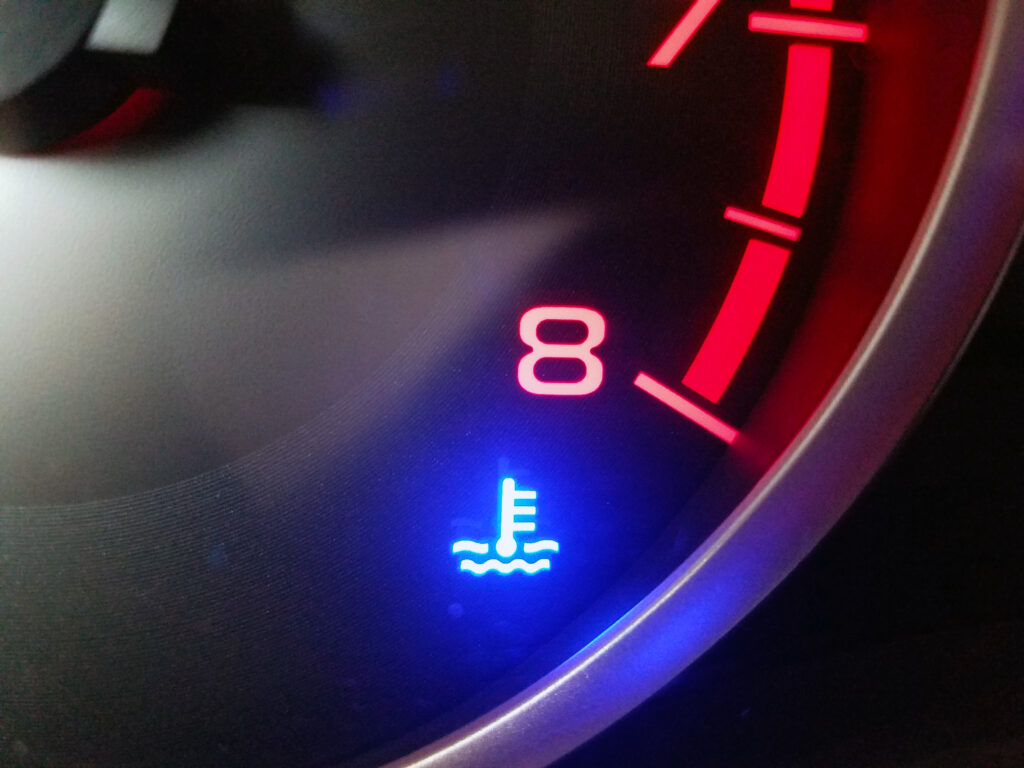
A symbol that resembles a thermometer atop wavy lines indicates the car’s coolant temperature, a key component to safe vehicle operation. This icon often appears after you’ve started the car in colder temperatures and is commonly found in newer Mazda and Subaru models. It indicates that the engine hasn’t yet reached its optimal operating temperature, and you should drive conservatively.
When the blue light disappears, you can push engine performance to merge onto the highway, begin towing a heavy load, or climb a steep grade. However, if the thermostat light appears red and blinks, it indicates that the engine temperature has exceeded healthy levels. When the red thermostat light stays solid, your car’s engine has overheated.
Does a Blue Dashboard Light Mean My Car Needs Servicing?
Under normal operating conditions, a blue dashboard light does not necessarily indicate that your car requires servicing. However, it’s best to assess the situation to determine if the blue light is appropriate. For example, if your high beams are on, you only need to turn them off during the day when you can see and if there’s a car approaching from the other direction.
If the blue thermostat light stays on after your car has reached operating temperature, it could indicate one or more of the following issues:
Did you have your vehicle’s coolant flushed recently? If a pocket of air enters the cooling system during the flush, it can cause the temperature sensor readings to fluctuate. The temperature variance could be sufficient to cause the sensor to misread the coolant temperature as lower than it actually is.
Identifix Direct-Hit: Next-Level Tools for Superior Car Care
As you drive your car and pass various mileage intervals, you’ll learn what each dashboard light corresponds to through experience. However, you can also consult Identifix Direct-Hit and Direct-Hit Mobile to streamline the process with Quick Hits and Specifications, including any necessary diagnostics and repairs. Contact us to learn more about how you can implement Identifix to simplify routine car maintenance.
Did you like this article? Find more great content at identifx.com/blogs and solera.com/blog.
Identifix is the leading provider of automotive repair shop solutions and sevices designed to improve shop profitability and repair outcomes.

"*" indicates required fields