
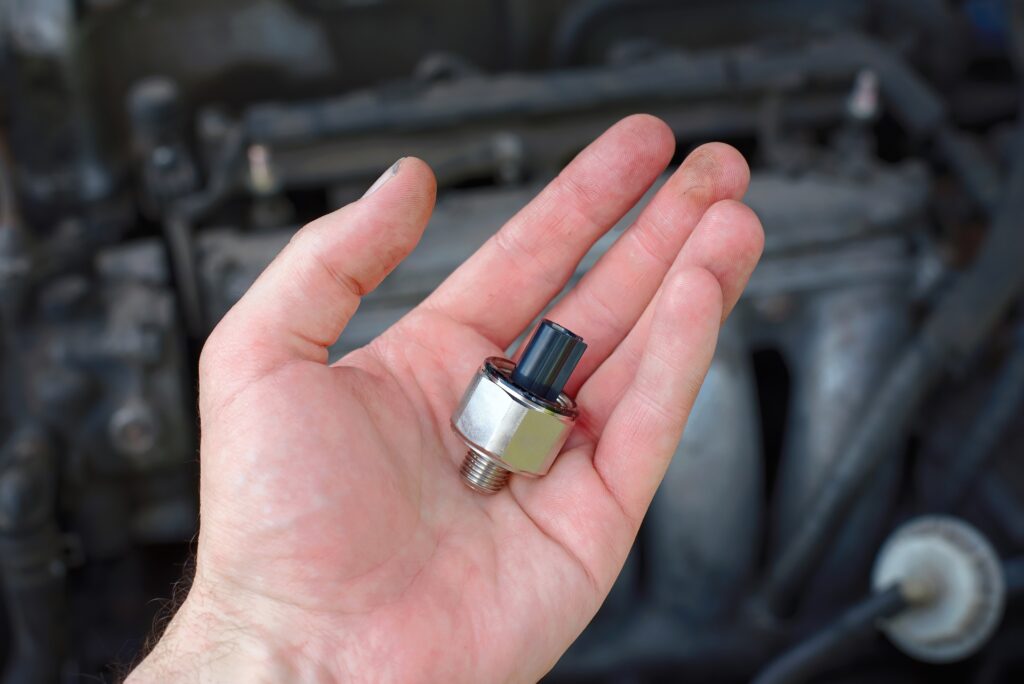
Diagnostic Trouble Code (DTC) P0332: Knock Sensor 2 Circuit Low Input (Bank 2) indicates that the powertrain control module (PCM) detects a lower voltage output than expected from the second knock sensor in the engine’s second bank.
While this low-voltage signal indicates an issue with the knock sensor or its wiring and connections specifically, it can also mean that the knock sensor is unable to alert the PCM to an actual knock if one exists. Severe knocking gone undetected can put the engine at risk of premature failure.
The comprehensive guide below explores the symptoms and causes commonly associated with DTC P0332 before outlining the diagnostic and repair steps involved in resolving any existing issues. Please note that the information provided is neither exhaustive nor explicitly tailored to a particular make, model, or model year, although this type of trouble code is often found on LS-series engines for reasons detailed below. For the most detailed diagnostic and repair steps, consult Identifix Direct-Hit® to access deeper test-plan details and thorough diagnostic resources designed to streamline repairs.
What Does DTC P0332 Mean?
A P0332 code signals that the knock sensor in Bank 2 isn’t functioning as expected. Each bank relies on a separate knock sensor to detect conditions such as pre-ignition and detonation, which can lead to severe internal engine damage if left unaddressed. Pre-ignition refers to the ignition of the air-fuel mixture before the spark plug ignites, whereas uncontrolled combustion of this mixture characterizes detonation.
Should the knock sensor detect engine knock, it will alert the PCM to retard timing. Only after the knock ceases will the PCM return timing to normal. However, when the knock sensor’s voltage is lower than the expected range—as determined by the manufacturer—it fails to deliver the necessary feedback to the PCM, resulting in a P0332 code.
Common Symptoms of Code P0332
Check engine lights are the most common symptom associated with DTC P0332. However, other symptoms include:
If your car exhibits any of these symptoms, including a check engine light, it’s best to pull off the road, shut off the engine, and call a tow truck as soon as you can. If you’re within a few miles of your mechanic or home, the engine will likely hold on until you get there. However, continuing to drive with DTC P0332 can put your engine at risk of premature failure.
What Can Cause a DTC P0332?
A P0332 code can occur in any engine with two banks and two corresponding knock sensors. However, it’s most common on Chevrolet’s LS-series V8 engines. An unfortunate design flaw in the engine’s shape allows water to pool beneath the intake manifold and around the knock sensor.
Common causes of DTC P0332 also include the following:
Seemingly unrelated conditions that can lead to a P0332 code include problems with the exhaust gas recirculation (EGR) system, a lean air-fuel ratio, a malfunctioning cooling system, and—rarely—a faulty powertrain control module. Diagnosing and repairing these causes requires separate protocols from what’s listed below. However, it’s best to rule out any issues with the knock sensor first to ensure a thorough diagnosis.
How to Diagnose P0332 Code
Diagnosing DTC P0332 requires gathering information about various electrical and mechanical components related to the engine’s two knock sensors. A thorough diagnosis is vital to ensuring you’ve resolved the problem, at least for the foreseeable future. Below are the basic steps involved in diagnosing a P0332 code.
Scan for Additional Codes
Starting with an OBD-II scan tool can help you pinpoint the cause of a P0332 code. As you check for this code, scan for additional related codes that can offer some insight. If any correspond to another system, add that to your diagnostic to-do list after you’ve inspected the knock sensor.
Visually Inspect the Knock Sensor Wiring and Connections
A visual inspection can help uncover the cause of faulty wiring or connections that prevent the knock sensor from communicating effectively with the PCM. Inspect the sensor body, connector, and wiring for signs of corrosion or damage. Improper installation and a loose connection can also contribute to a P0332 code.
Verify Knock Sensor Voltage and Resistance
With the key in the ON position, disconnect the knock sensor connector and measure the voltage between the white-grey pin and the black-grey pin. If the reading is 5 volts, the sensor functions properly, but if not, inspect the wiring from the knock sensor to the PCM for open or short circuits. A measure of the knock sensor’s resistance should return an infinite value, but if it doesn’t, it’s highly likely that the knock sensor must be replaced.
Repairing the Underlying Cause of DTC P0332
Replacing the knock sensor may seem like the obvious solution in the case of a DTC P0332, but that doesn’t always address the root cause. Instead, it’s best to complete a thorough diagnosis and repair or replace any malfunctioning or broken components, including the knock sensor wiring or connectors. If you do replace the knock sensor, replace the harness simultaneously.
Should you uncover additional underlying causes, address those before ensuring every repaired or replaced component functions properly. Clear any codes before taking a test drive to confirm the resolution of these issues.
Final Thoughts on Diagnosing and Repairing Code P0332
Like many other mechanical and electrical components, knock sensors can wear out over time and require replacement. Reference Identifix Direct-Hit to access model-specific repair information to simplify diagnosing DTC P0332 and complex codes like it. Contact us to learn more about our auto repair information software, including how to use our new Direct-Hit Mobile application for completing repairs at the source.
Did you like this article? Find more great content at identifx.com/blogs and solera.com/blog.

Identifix is the leading provider of automotive repair shop solutions and sevices designed to improve shop profitability and repair outcomes.

"*" indicates required fields